Novelist and essayist James Baldwin began a project, shortly before he died, to explore recent American history reflected through the lens of three pivotal figures: Medgar Evers, Malcolm X, and Martin Luther King. These three figures represent three aspects of African American thought in the mid-20th century. Baldwin's voice adds a fourth dimension to the narrative.
Baldwin's narration in the movie, spoken by Samuel L. Jackson, weaves the themes of how America defines its heroes, the concept of racial "purity," the narrative of "innocence" despite a history of violence, and what it means to be a "witness." Baldwin wraps these themes around his encounters with Medgar, Malcolm and Martin and their widows.
The movie begins with Baldwin in exile, in France, contemplating what it means to "pay one's dues," during the struggle for racial equality in the United States. His reflections on being a bystander, and also on many of his countrymen's apathy and indifference toward that effort, lead him to return home. As a writer, he must be a witness to history and document it.
The central question in the film, as Baldwin articulates it, is not "What will become of the [Black American]?" but "What will become of America" if it continues on the path on which it is headed?
An underlying question throughout the film is, "What is the state of a civilization that produces such violence?"
Baldwin evaluates American history not so much by its words or its professed ideals, but by the behavior of its institutions, especially its religious institutions.
Noting that the present is both a departure from, and a continuation of the past Baldwin writes, at one point in the film: "We are our history."
At another point, he makes an observation that might serve as the overarching theme and the purpose of making the movie: "Not everything that is faced can be changed, but nothing can change until it has been faced."
Sunday, February 19, 2017
Friday, January 20, 2017
When Character and Virtue are Tested...
Tonight I saw the movie Silence, which Martin Scorsese directed. The truth of the matter is that I wasn't looking forward to seeing the film because I thought it would be an overly-simplified, Western "good guys" versus Eastern "bad guys" movie. It wasn't like that at all.
This was a complex film about two Jesuit priests who ventured in 17th century Japan under conditions of religious repression. They were searching for a priest who arrived in the country earlier and was said to have become an apostate.
The movie was also as much about the enduring faith of the peasantry, after more than a generation of brutal treatment to destroy their communities, as it was about the fate of the three priests who were focal points in the story.
The acting was engaging, and the scenery was enthralling. The script and the story were intellectually stimulating. The movie depicted the often subtle methods of psychological torture along with the more direct forms of physical abuse.
Friends who have read the novel that the movie is based on said that the film is an accurate depiction of the printed text. The book itself is based on real events. A key theme in the film centers on the question of where God is in the midst of suffering. A brief passage offers an answer: one encounters God in the midst of the silence.
Although it was a thought-provoking film, it is not for an audience that has a short attention-span or for people who are uncomfortable and impatient with exploring the complexities of character and judgment.
The script presented compelling arguments about whether or not truth is universal or merely culturally-specific; the efficacy of symbolism and names, and the real meaning of "mercy."
If you watch this movie with a friend, or two, or six -- make sure you allow time for a good discussion afterward. You will most likely find yourself talking about the film for hours.
This was a complex film about two Jesuit priests who ventured in 17th century Japan under conditions of religious repression. They were searching for a priest who arrived in the country earlier and was said to have become an apostate.
The movie was also as much about the enduring faith of the peasantry, after more than a generation of brutal treatment to destroy their communities, as it was about the fate of the three priests who were focal points in the story.
The acting was engaging, and the scenery was enthralling. The script and the story were intellectually stimulating. The movie depicted the often subtle methods of psychological torture along with the more direct forms of physical abuse.
Friends who have read the novel that the movie is based on said that the film is an accurate depiction of the printed text. The book itself is based on real events. A key theme in the film centers on the question of where God is in the midst of suffering. A brief passage offers an answer: one encounters God in the midst of the silence.
Although it was a thought-provoking film, it is not for an audience that has a short attention-span or for people who are uncomfortable and impatient with exploring the complexities of character and judgment.
The script presented compelling arguments about whether or not truth is universal or merely culturally-specific; the efficacy of symbolism and names, and the real meaning of "mercy."
If you watch this movie with a friend, or two, or six -- make sure you allow time for a good discussion afterward. You will most likely find yourself talking about the film for hours.
Saturday, January 14, 2017
Fences, Collateral Beauty, Moonlight, and Hidden Figures: Movie Reviews
August Wilson's Fences explores a family caught between changing times and the ghosts of the past, and it conjures up the sights and sounds of the City of Pittsburgh during the 1950s.
The film is based on Wilson's play. It is heavily driven by dialogue and the complexity of the lives of the movie's main characters. For those who are tired of movies that overwhelm the senses with noise and visual special effects, Fences will be a refreshing change.
The movie is like walking into the scenes of a play and becoming part of the story. The script will appeal to those who are not interested in mostly going to movies for an escape. The family's story will reach into your heart, but you will get the most out of the film if you pay close attention to Wilson's use of two key metaphors: baseball and fences.
These two metaphors intensify an already emotionally powerful movie.
Fences is a gut-wrenching portrayal of growing old, coming of age, and coping with the hopes and disappointments of everyday life. Through moments of joy and sorrow, there is a touch of a miracle.
Collateral Beauty is likely to appeal to those who have a spiritual or a metaphysical bent. The movie draws out the way that literature addresses the topics of love, death and time. There were moments during the film when I thought that the screenwriter and the actors were trying too hard to be profound.
From the standpoint of storytelling, I thought that the movie sacrificed a well-crafted storyline to emphasize its message. The narrative aspect of the story was predictable and weak. There were parts in the third act that were downright hokey.
Also, the central character, which was played by Will Smith, was one-dimensional. It was hard to become emotionally invested in a character whose two emotions were angst and angst. And it was hard to understand why Jacob Latimore was selected for this film unless it was for his looks or to draw upon his fan base. It certainly wasn't because of his acting skills.
Nonetheless, it was a movie that left, for me, a ponderous aftertaste, especially once I had a chance to sleep on it.
There are two "ah-ha" moments in the movie; one which is explicit during the climax of the film and the other which is implied at the very end.
These ah-ha moments, especially the one hinted at the end, along with the use of literature to explore how we think about love, death and time, ultimately made the movie worth seeing.
Moonlight is a sensitive portrayal, which is artistically filmed, of a young man who is bullied by his peers and who lacks family support at home. In the pattern of the parable of "The Good Samaritan," he gains care and compassion from a most unlikely character in the story.
The filming was stunning, regarding color, setting, and imagery. The director's use of nonverbal communication through facial expressions, in particular with the lead character as a boy, was powerful, reminding me of the facial expressions in Pasolini's The Gospel According to St. Matthew'.
The narrative was choppy, although I believe the director and screenwriter were going for an "artsy" effect. Rather than holding together as a story, which would have allowed for character development and complications that would lead to a climax and resolution, the writer and director relied on a fragmented selection of scenes. These fragments will move the viewer to tears, but they are ultimately devoid of an underlying story or satisfactory transitions between each leap in the three stages of the protagonist's development.
The movie includes sensitive subject-matter concerning violence, sexuality, and substance abuse. It is not light viewing, but worth seeing for thoughtful audiences.
Hidden Figures is based on the true story of three women who worked for NASA in the 1960s through the early 1970s, overcoming social conventions and assumptions to make vital contributions to America's space program.
Not only were these women "hidden figures" because it did not fit the dominant narrative to acknowledge their contributions, but they also had to create resources and opportunities for themselves that others took for granted as being "just the way things are."
The title is a play on words reflecting both the method of cracking the puzzle of manned space flight (look for the "hidden figure" which conventional math cannot detect) and the practice of hiding these women's contributions from history.
The acting was excellent, and the story held the audience in suspense, which was quite a feat given the fact that we already knew the outcome of the main event that served as a backdrop for the story.
I recommend that parents bring their sons and daughters, teachers bring their students and moviegoers of all ages just kick back and enjoy the film. Your time will be well spent.
It was a gripping story with a subtle but timeless message: no nation or institution can afford to continue to waste and undermine its own talent, and real leadership requires the capacity to think anew rather than to suppress genius.
The film is based on Wilson's play. It is heavily driven by dialogue and the complexity of the lives of the movie's main characters. For those who are tired of movies that overwhelm the senses with noise and visual special effects, Fences will be a refreshing change.
The movie is like walking into the scenes of a play and becoming part of the story. The script will appeal to those who are not interested in mostly going to movies for an escape. The family's story will reach into your heart, but you will get the most out of the film if you pay close attention to Wilson's use of two key metaphors: baseball and fences.
These two metaphors intensify an already emotionally powerful movie.
Fences is a gut-wrenching portrayal of growing old, coming of age, and coping with the hopes and disappointments of everyday life. Through moments of joy and sorrow, there is a touch of a miracle.
Collateral Beauty is likely to appeal to those who have a spiritual or a metaphysical bent. The movie draws out the way that literature addresses the topics of love, death and time. There were moments during the film when I thought that the screenwriter and the actors were trying too hard to be profound.
From the standpoint of storytelling, I thought that the movie sacrificed a well-crafted storyline to emphasize its message. The narrative aspect of the story was predictable and weak. There were parts in the third act that were downright hokey.
Also, the central character, which was played by Will Smith, was one-dimensional. It was hard to become emotionally invested in a character whose two emotions were angst and angst. And it was hard to understand why Jacob Latimore was selected for this film unless it was for his looks or to draw upon his fan base. It certainly wasn't because of his acting skills.
Nonetheless, it was a movie that left, for me, a ponderous aftertaste, especially once I had a chance to sleep on it.
There are two "ah-ha" moments in the movie; one which is explicit during the climax of the film and the other which is implied at the very end.
These ah-ha moments, especially the one hinted at the end, along with the use of literature to explore how we think about love, death and time, ultimately made the movie worth seeing.
Moonlight is a sensitive portrayal, which is artistically filmed, of a young man who is bullied by his peers and who lacks family support at home. In the pattern of the parable of "The Good Samaritan," he gains care and compassion from a most unlikely character in the story.
The filming was stunning, regarding color, setting, and imagery. The director's use of nonverbal communication through facial expressions, in particular with the lead character as a boy, was powerful, reminding me of the facial expressions in Pasolini's The Gospel According to St. Matthew'.
The narrative was choppy, although I believe the director and screenwriter were going for an "artsy" effect. Rather than holding together as a story, which would have allowed for character development and complications that would lead to a climax and resolution, the writer and director relied on a fragmented selection of scenes. These fragments will move the viewer to tears, but they are ultimately devoid of an underlying story or satisfactory transitions between each leap in the three stages of the protagonist's development.
The movie includes sensitive subject-matter concerning violence, sexuality, and substance abuse. It is not light viewing, but worth seeing for thoughtful audiences.
Hidden Figures is based on the true story of three women who worked for NASA in the 1960s through the early 1970s, overcoming social conventions and assumptions to make vital contributions to America's space program.
Not only were these women "hidden figures" because it did not fit the dominant narrative to acknowledge their contributions, but they also had to create resources and opportunities for themselves that others took for granted as being "just the way things are."
The title is a play on words reflecting both the method of cracking the puzzle of manned space flight (look for the "hidden figure" which conventional math cannot detect) and the practice of hiding these women's contributions from history.
The acting was excellent, and the story held the audience in suspense, which was quite a feat given the fact that we already knew the outcome of the main event that served as a backdrop for the story.
I recommend that parents bring their sons and daughters, teachers bring their students and moviegoers of all ages just kick back and enjoy the film. Your time will be well spent.
It was a gripping story with a subtle but timeless message: no nation or institution can afford to continue to waste and undermine its own talent, and real leadership requires the capacity to think anew rather than to suppress genius.
Sunday, August 7, 2016
Christ: Two Views of Kingship and Love
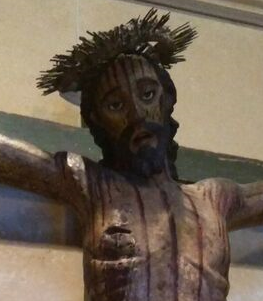
The thing that struck me the most about two contrasting images of Christ in St. Cecilia Cathedral in Omaha was how the two images showed very different notions of "kingship" and love: the kingship of triumph and the kingship of vulnerability; love characterized by longing and love characterized by fulfillment.
The first image is a crucifix from Mexico or Central America. It graphically shows the suffering and humiliation of Christ on the cross. The wounds on his body are open; the expression on his face is gaunt; his mouth hangs open and his eyes seem hollow, as if he is on the verge of death.
The second image in the Cathedral shows an older, stronger and more mature Christ. This is Christ triumphant -- Christ enthroned in his victory. His body seems stocky and sturdy with power.
Both images -- Christ humiliated, suffering and dying, and Christ resurrected, triumphant and reigning over the New Creation -- are expressions of Jesus' transcendent love and mercy. Love is shown in the image of Christ on the cross, bleeding the substance of his life as he gives without holding anything back. Love is also shown in the image of Christ enthroned, because his sacred heart figures prominently. His heart is surrounded by thorns and inflamed with the fire of passion for humanity.
There is something to be said for using thorns and fire to depict a loving heart. It feels good to be drawn out of oneself and into the life of another, yet this self-transcending love also entails pain and suffering. When one is drawn out of oneself and into the life of another, one suffers the longing of separation from the beloved. One also feels pain when one is helpless to protect the beloved from the physical and emotional pain of everyday life. To love is to experience the pain of limitation. This pain is inseparable from the joy of being in love. To love is to be wounded.
It might sound strange to associate love with a wound, but anyone who has ever been in love -- not only romantically, but also in the form of friendship or the protective love one might have toward a child, or a disabled or aged adult -- knows the pain that accompanies the pleasure of pouring out one's heart for the sake of another, and the realization that even to give one's life would not be enough to express the intensity of one's devotion to the well-being of the other.
Love is pain mixed with ecstasy as one wants to be with the beloved at all times, even though this would be neither practical nor desirable. Love is the ecstasy and suffering that one experiences when one wants to do everything possible to heal the pain and the suffering of the beloved. This is where we encounter Christ. We encounter Christ through the pain and ecstasy of self-transcending love.
A person who loves is simultaneously whole and wounded; a person who loves simultaneously experiences the joy of knowing that one's existence has meaning, and the pain of knowing that one is incapable of adequately expressing one's love.
When you are in love you forget yourself for a period of time and you are completely consumed by your desire for the well-being of another. There is a sense of fulfillment, which is the emotional reward of love, and a sense of emptiness, as you long to embrace, accompany, and console the beloved when the beloved is not present.
When the beloved is absent, you do not stop being in love, rather you live your love through longing and desire. Whether as lover or as beloved, when you are apart, you feel an absence that you could never feel without knowing the fullness that comes from having someone in your life who gives your life meaning and purpose.
Being loved and being in love gives you a reason to go on living. When you are loved you are strengthened to be a better person, in order to be more worthy of the love that someone else has entrusted you with, even though love is something that can never be earned.
When you are loved you feel as though you are understood, and accepted for who you are, even as you strive, in response to love, to be something more.
You feel as though the lover, uniquely, sees into your soul and sees you as you really are, yet loves you in spite of this -- even because of it. There is nothing you need conceal from your lover because your lover loves you in your strengths and in your weaknesses -- especially in your weaknesses.
As you are convicted by this unrelenting love, often mixed with frustration and disappointment for both the lover and the beloved, you strive to reduce the pain and the suffering that you cause in this relationship.
You encounter the true nature of love -- you encounter Christ -- when you reject the temptation to reject one of the dimensions of his personhood. You cannot encounter Christ if you only focus on the pain of love -- and on his suffering and death. You also have to experience the joy of love -- and of Christ's resurrection and triumph. Likewise, you cannot encounter Christ if you only embrace the joy of his resurrection while excluding his humiliation, suffering and death.
The Christ who died as an outcast and a criminal, in utter poverty, is the same Christ who rose triumphantly, and has begun his reign over all creation.
Both images of Christ signify his kingship. There is the kingship of Christ crowned with thorns and enthroned on a cross, and the kingship of Christ crowned with victory and enthroned as the head of the New Creation. It is necessary to embrace the one form of kingship in order to embrace the other.
The crucifixion is inseparable from the resurrection; suffering and humiliation are inseparable from the victory and glory of God. The joy and the pain of our love for an absent lover is an icon for our love for a God whose presence we do not always feel. It is also an icon for God's unrelenting love for us, even as we turn away to avoid God's love.
The first image is a crucifix from Mexico or Central America. It graphically shows the suffering and humiliation of Christ on the cross. The wounds on his body are open; the expression on his face is gaunt; his mouth hangs open and his eyes seem hollow, as if he is on the verge of death.
The second image in the Cathedral shows an older, stronger and more mature Christ. This is Christ triumphant -- Christ enthroned in his victory. His body seems stocky and sturdy with power.
Both images -- Christ humiliated, suffering and dying, and Christ resurrected, triumphant and reigning over the New Creation -- are expressions of Jesus' transcendent love and mercy. Love is shown in the image of Christ on the cross, bleeding the substance of his life as he gives without holding anything back. Love is also shown in the image of Christ enthroned, because his sacred heart figures prominently. His heart is surrounded by thorns and inflamed with the fire of passion for humanity.
There is something to be said for using thorns and fire to depict a loving heart. It feels good to be drawn out of oneself and into the life of another, yet this self-transcending love also entails pain and suffering. When one is drawn out of oneself and into the life of another, one suffers the longing of separation from the beloved. One also feels pain when one is helpless to protect the beloved from the physical and emotional pain of everyday life. To love is to experience the pain of limitation. This pain is inseparable from the joy of being in love. To love is to be wounded.
It might sound strange to associate love with a wound, but anyone who has ever been in love -- not only romantically, but also in the form of friendship or the protective love one might have toward a child, or a disabled or aged adult -- knows the pain that accompanies the pleasure of pouring out one's heart for the sake of another, and the realization that even to give one's life would not be enough to express the intensity of one's devotion to the well-being of the other.
Love is pain mixed with ecstasy as one wants to be with the beloved at all times, even though this would be neither practical nor desirable. Love is the ecstasy and suffering that one experiences when one wants to do everything possible to heal the pain and the suffering of the beloved. This is where we encounter Christ. We encounter Christ through the pain and ecstasy of self-transcending love.
A person who loves is simultaneously whole and wounded; a person who loves simultaneously experiences the joy of knowing that one's existence has meaning, and the pain of knowing that one is incapable of adequately expressing one's love.
When you are in love you forget yourself for a period of time and you are completely consumed by your desire for the well-being of another. There is a sense of fulfillment, which is the emotional reward of love, and a sense of emptiness, as you long to embrace, accompany, and console the beloved when the beloved is not present.
When the beloved is absent, you do not stop being in love, rather you live your love through longing and desire. Whether as lover or as beloved, when you are apart, you feel an absence that you could never feel without knowing the fullness that comes from having someone in your life who gives your life meaning and purpose.
Being loved and being in love gives you a reason to go on living. When you are loved you are strengthened to be a better person, in order to be more worthy of the love that someone else has entrusted you with, even though love is something that can never be earned.
When you are loved you feel as though you are understood, and accepted for who you are, even as you strive, in response to love, to be something more.
You feel as though the lover, uniquely, sees into your soul and sees you as you really are, yet loves you in spite of this -- even because of it. There is nothing you need conceal from your lover because your lover loves you in your strengths and in your weaknesses -- especially in your weaknesses.
As you are convicted by this unrelenting love, often mixed with frustration and disappointment for both the lover and the beloved, you strive to reduce the pain and the suffering that you cause in this relationship.
You encounter the true nature of love -- you encounter Christ -- when you reject the temptation to reject one of the dimensions of his personhood. You cannot encounter Christ if you only focus on the pain of love -- and on his suffering and death. You also have to experience the joy of love -- and of Christ's resurrection and triumph. Likewise, you cannot encounter Christ if you only embrace the joy of his resurrection while excluding his humiliation, suffering and death.
The Christ who died as an outcast and a criminal, in utter poverty, is the same Christ who rose triumphantly, and has begun his reign over all creation.
Both images of Christ signify his kingship. There is the kingship of Christ crowned with thorns and enthroned on a cross, and the kingship of Christ crowned with victory and enthroned as the head of the New Creation. It is necessary to embrace the one form of kingship in order to embrace the other.
The crucifixion is inseparable from the resurrection; suffering and humiliation are inseparable from the victory and glory of God. The joy and the pain of our love for an absent lover is an icon for our love for a God whose presence we do not always feel. It is also an icon for God's unrelenting love for us, even as we turn away to avoid God's love.
Monday, July 25, 2016
St. Cecilia Cathedral and the 22nd Psalm
Images from St. Cecilia Cathedral in Omaha that inspire prayerful reflection on an adaptation of the 22nd Psalm:
![]() |
| Image Credit: C. Matthew Hawkins |
My God, my God, why have you abandoned me? Why so far from my call for help, from my cries of anguish?
My God, I call by day, but you do not answer; by night, but I have no relief.
I am a worm, not a man, scorned by men, despised by the people.
All who see me mock me; they curl their lips and jeer; they shake their heads at me:
"He relied on the LORD -- let him deliver him; if he loves him, let him rescue him."
Many bulls of Bashan encircle me. They open their mouths against me, lions that rend and roar.
Like water my life drains away; all my bones are disjointed.
My heart has become like wax, it melts away within me.
As dry as a potsherd is my throat; my tongue cleaves to my palate; you lay me in the dust of death.
Dogs surround me; a pack of evildoers closes in on me.
They have pierced my hands and my feet; I can count all my bones.
![]() |
| Image Credit: C. Matthew Hawkins |
But you, LORD, do not stay far off; my strength, come quickly to help me.
Deliver my soul from the sword, my life from the grip of the dog.
Save me from the lion's mouth, my poor life from the horns of wild bulls.
For you drew me forth from the womb, made me safe at my mother's breasts.
Upon you I was thrust from the womb; since my mother bore me you are my God.
Do not stay far from me, for trouble is near, and there is no one to help.
![]() |
| Image Credit: C. Matthew Hawkins |
I will proclaim your name to my brethren; in the assembly I will praise you:
"You who fear the LORD, give praise! All descendants of Jacob, give honor; show reverence, all descendants of Israel!
"For he has not spurned or disdained the misery of this poor wretch, Did not turn away from me, but heard me when I cried out.
"I will offer praise in the great assembly; my vows I will fulfill before those who fear him.
"The poor will eat their fill; those who seek the LORD will offer praise. May your hearts enjoy life forever!"
![]() |
| Image Credit: C. Matthew Hawkins |
All the ends of the earth will remember and turn to the LORD; All the families of nations will bow low before him.
For kingship belongs to the LORD, the ruler over the nations.
All who sleep in the earth will bow low before God; All who have gone down into the dust will kneel in homage.
And I will live for the LORD; my descendants will serve you.
The generation to come will be told of the LORD, that they may proclaim to a people yet unborn the deliverance you have brought.
This post was created while participating in the Institute for Priestly Formation (IPF) at Creighton University in the summer of 2016.
Monday, July 11, 2016
Petitions of Hope for a Troubled Land
![]() |
The World was created by the Word of God, re-created by his redemption, and it is continually renewed by his love, Rejoicing in him we call out:
Renew the wonders of your love, Lord.
We give thanks to God whose power is revealed in nature, and whose providence is revealed in history.
Renew the wonders of your love, Lord.
Through your Son, the herald of reconciliation, the victor of the cross, free us from empty fear and hopelessness.
Renew the wonders of your love, Lord.
May all those who love and pursue justice work together without deceit to build a world of true peace.
Renew the wonders of your love, Lord.
Be with the oppressed, free the captives, console the sorrowing, feed the hungry, strengthen the weak, in all people reveal the victory of your cross.
Renew the wonders of your love, Lord.
After your Son's death and burial you raised him up again in glory, grant that the faithful departed may live with him.
Renew the wonders of your love, Lord.
Entering Our Troubled Times Through Eyes of Faith
![]() |
| Image Credit: Dreamstime.com |
Also, Fr. James Martin S.J. posted an Icon, "Our Lady Mother of Ferguson and All Those Killed by Gun Violence," on his Facebook page.
He writes that it is “a new icon written by Mark Dukes,” which was sent to Fr. Martin by his friend, Rev. Mark Bozzuti-Jones of Trinity Church Wall Street.
Rev. Bozzuti-Jones commissioned the icon and it is now on display in his church.
Fr. Martin writes:
Our Lady prays for all who are targeted by gun violence: African-Americans, the poor and marginalized, and police officers.
![]() |
| Image Credit: Mark Dukes |
All are her children.
All are our brothers and sisters.
Let us ask Our Lady to pray for us.
Subscribe to:
Posts (Atom)